May 1, 2026 • Priya Nambiar • 9 min reading time • Prices verified June 18, 2026
Sunny Health & Fitness Rowers: Which of Their 8 Models Is Actually Right for You
If you’ve been shopping for a rowing machine and stumbled across Sunny Health & Fitness, you’ve probably noticed two things: the prices look almost suspiciously low, and there are a lot of models. A rowing machine — sometimes called an ergometer, or “erg” for short — is essentially a full-body cardio machine that mimics the motion of rowing a boat. Unlike a treadmill, it works your legs, core, and upper body simultaneously, which is why fitness coaches rate it so highly for efficient workouts. Sunny Health & Fitness is a Los Angeles-based brand that has carved out a strong position in the under-$500 category, and their rowing lineup alone spans eight distinct machines. That range is genuinely useful — but only if you know what separates them. This guide walks through every current Sunny rower, names the real tradeoffs, and ends with a clear decision rule so you can stop second-guessing and buy with confidence.
How Sunny Structures Their Lineup (And Why It Matters)
Before we get model-specific, you need to understand the two resistance technologies Sunny uses, because the choice between them shapes everything else — feel, noise, maintenance, and price.
Magnetic resistance uses magnets hovering near a metal flywheel (the weighted spinning disc that creates the pulling sensation). The gap between magnet and flywheel is adjusted — either manually via a dial or automatically via a motor — to change how hard you have to pull. It’s quiet, low-maintenance, and consistent. Almost all Sunny rowers use this system.
Hydraulic resistance uses small cylinders, like shock absorbers, attached to the handles. It’s extremely compact and cheap to manufacture. The tradeoff: the rowing stroke feels nothing like water, and the cylinders can wear unevenly over time.
Sunny also recently introduced a water resistance entry in the form of their SF-RW522000, though it remains a smaller part of their lineup compared to their magnetic core. Water resistance uses paddles spinning inside a tank of water — the harder you pull, the more resistance you create automatically, similar to how a real boat behaves.
By the numbers — Sunny’s 2026 rower price spread:
| Resistance Type | Entry Price | Top Price |
|---|---|---|
| Hydraulic | ~$150 | ~$200 |
| Magnetic (manual dial) | ~$220 | ~$380 |
| Magnetic (motorized) | ~$350 | ~$500 |
| Water | ~$450 | ~$500 |
These are approximate retail prices as of May 2026 and fluctuate regularly with sales and Amazon promotions.
The Eight Models, Ranked by Who They’re Actually For
1. SF-RW5515 — The Hydraulic Entry Point
This is Sunny’s most basic offering: a hydraulic piston rower with a compact footprint, roughly 47 inches long when assembled. At around $150–$170, it’s the machine you buy when budget is the only real constraint.
The honest tradeoff: the stroke mechanics feel like pulling two independent handles rather than a unified rowing motion. Owners consistently report it’s functional for light cardio but describe a feeling of “pushing against springs” rather than gliding through water. Shape’s review of Sunny’s entry-level hydraulics describes the stroke as “usable but noticeably different from a traditional rower.”
If X, then Y: If you have under $200 and genuinely just want low-impact movement for 15–20 minutes a day, the SF-RW5515 works. If you care at all about rowing form, technique transfer, or training metrics, skip it entirely.
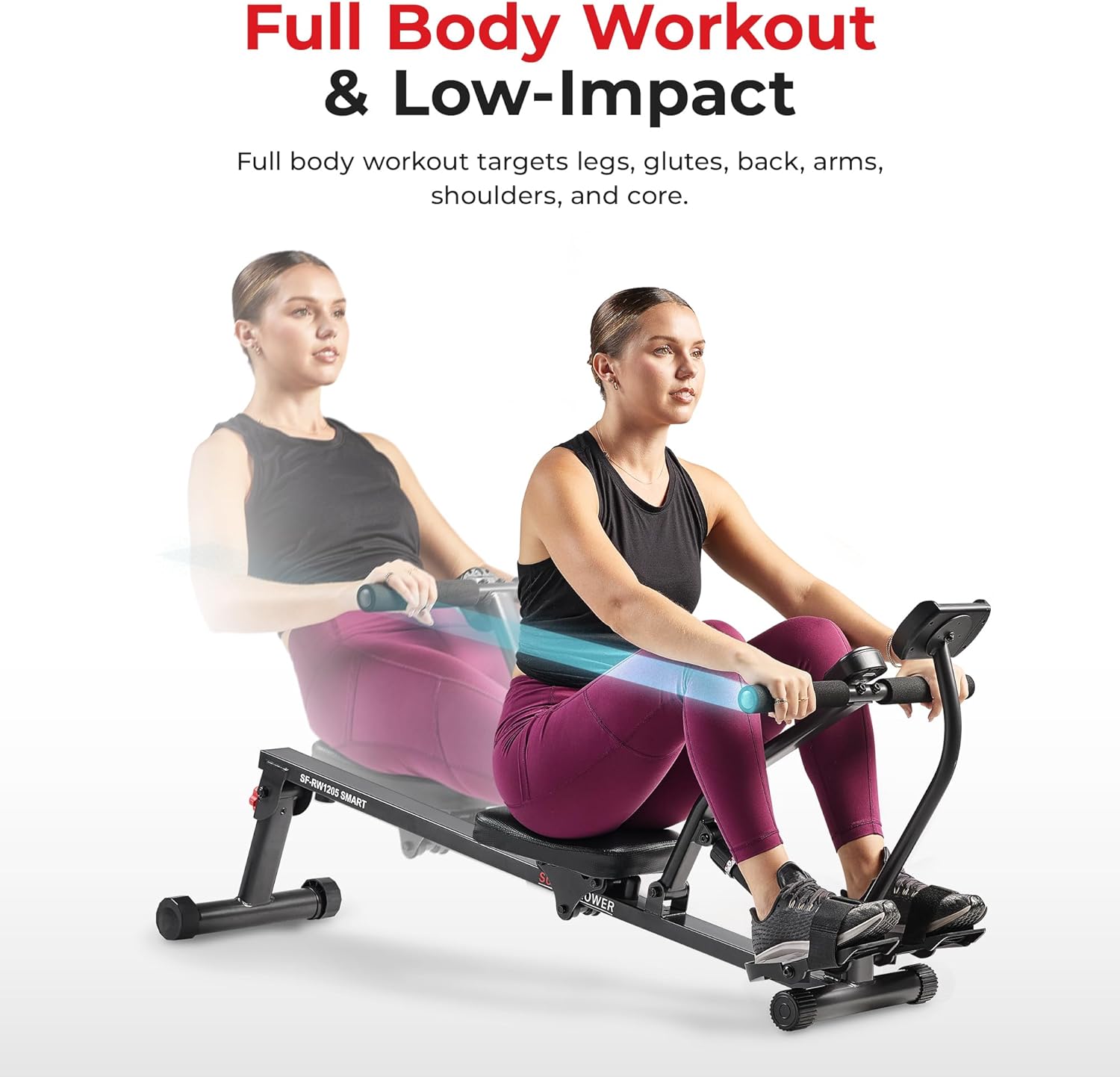
2. SF-RW1205 — The Compact Hydraulic Step-Up
Slightly more refined than the 5515, with adjustable resistance on each arm independently. It still uses hydraulic cylinders but adds a basic LCD monitor showing time, count, and calories. Priced around $180–$210.
The independent-arm design is sometimes marketed as a feature (each side can be set differently for “unilateral training”), but in practice most users keep both arms at the same resistance. Verywell Fit’s overview of budget rowers notes that hydraulic machines in this price tier are best understood as “starter tools rather than long-term training platforms.”
3. SF-RW5623 — The Magnetic Entry Point (Where Things Get Serious)
This is the first model in Sunny’s lineup that most fitness coaches would consider recommending without heavy caveats. It uses magnetic resistance with a manual tension knob (typically 8 resistance levels), a monitor that tracks strokes per minute (SPM), calories, time, and distance, and a sliding seat rail long enough to accommodate users up to around 6’1”.
Prices hover around $220–$260 in 2026. Owners consistently report a noticeably smoother stroke than the hydraulic models — still not Concept2-level, but mechanically coherent. Men’s Health’s budget rower roundup has repeatedly featured Sunny’s magnetic entry models as legitimate starting points for new rowers who plan to build a consistent habit.
The key limitation: No Bluetooth, no connectivity, no app integration. The monitor is functional but barebones. If you want to track split times (the time it takes to row 500 meters — the standard unit of rowing performance) or watts, you won’t get that here.
4. SF-RW5801 — Magnetic with a Better Monitor
Consider this the RF-RW5623’s more data-literate sibling. It adds a larger LCD display, a hand-pulse heart rate sensor built into the handles, and a slightly sturdier frame rated for users up to 250 lbs (vs. 220 lbs on the 5623). Price range: approximately $270–$320.
The heart rate feature is worth a sentence of honesty: optical and contact-based grip sensors on budget machines are notoriously inconsistent. Wirecutter’s rowing machine guide explicitly notes that chest-strap heart rate monitors (sold separately, typically $30–$60) outperform grip sensors across all price tiers. Don’t buy this model specifically for the HR feature — buy it if you want a slightly beefier frame and a cleaner monitor layout.
5. SF-RW5941 — The Motorized Magnetic Upgrade
Here’s where Sunny introduces motorized magnetic resistance — meaning the machine adjusts resistance electronically via a motor rather than a manual dial. This opens the door to programmed workouts stored in the monitor: pre-set intervals, target heart rate programs, and multi-stage sessions.
At around $350–$400, the SF-RW5941 also pairs via Bluetooth to Sunny’s companion app (Sunny Health & Fitness App, available iOS and Android). The app provides additional workout programs, basic data logging, and compatibility with some third-party fitness platforms.
The practical value of motorized resistance: smoother mid-workout adjustments. On a manual dial machine, you have to stop your stroke briefly to change resistance. Motorized systems let you program a pyramid interval (progressively harder then easier effort levels) without breaking rhythm.
Owners report the app experience is functional but not richly featured — think basic logging and guided sessions rather than the immersive library Hydrow or Ergatta provide. If you’re building a structured program from a coach’s spreadsheet rather than following on-screen classes, the app limitations won’t bother you.
6. SF-RW5954 — Magnetic, Folding, Motorized
Functionally similar to the SF-RW5941, but with a folding frame design that reduces the footprint significantly when stored. This is the right choice for apartment training or any space where the rower needs to disappear between sessions.
Price: approximately $380–$430. The tradeoff for the folding mechanism is a slight increase in frame flex during aggressive rowing — multiple longer-run reviews note that at very high stroke rates (above 28 SPM), the SF-RW5954 feels marginally less rigid than non-folding competitors at the same price. For steady-state cardio and moderate-intensity intervals, it’s a non-issue.
If X, then Y: If storage is a hard constraint and you’re rowing at moderate intensity (not training for a sprint race), the SF-RW5954 is Sunny’s best space-efficiency answer.
7. SF-RW522000 — The Water Rower Entry
This is Sunny’s first meaningful step into water resistance, and it’s worth a separate treatment. The SF-RW522000 uses a polycarbonate water tank with paddles — the same fundamental mechanism as the WaterRower — and produces the characteristic gentle whooshing sound that many rowers find more motivating than the mechanical hum of a magnetic machine.
Published specs put the weight capacity at 250 lbs and the tank at a fixed water volume (unlike some water rowers, it is not a variable-water-volume design, which limits fine-tuning of resistance). Price: approximately $450–$500.
The honest comparison: this machine is significantly less refined than the WaterRower Club ($1,200) or even the LifeCORE RC-100ARW, but it gives you water resistance feel at roughly one-third the price. Shape’s Sunny coverage notes the SF-RW522000 is “a genuine entry into the water resistance experience, though the frame materials and build tolerance reflect the price point.”
For a buyer who wants water feel, doesn’t want to spend over $500, and accepts that durability will be closer to the budget tier than the mid-range: this machine earns its place.
8. SF-RW220011 — The Full-Featured Magnetic Flagship
Sunny’s top magnetic model bundles the motorized resistance system with a larger 4.8-inch LCD console, pre-programmed workouts (typically 12 built-in programs), and a sturdier steel frame rated for users up to 300 lbs — meaningfully higher than most of their lineup.
Price: approximately $470–$520. This is also where Sunny’s extended warranty support tends to be strongest; commercial reviews consistently note that Sunny’s customer service is more responsive on their higher-end SKUs.
For a serious home-gym builder who wants the best Sunny can deliver without moving to Concept2 or Hydrow pricing: this is it. You still won’t get split-time data in the competitive 500m format, and Bluetooth connectivity is limited to the Sunny app ecosystem rather than third-party platforms like Kinomap or ErgData. But the build quality is noticeably more substantial.
The Decision Frame: Which Sunny Rower Should You Actually Buy?
Here’s the honest summary, built as a decision rule:
If you’re under $200 and space-constrained: SF-RW1205 (hydraulic). Understand the stroke limitations going in.
If you’re a first-time rower who wants a real magnetic machine under $300: SF-RW5623. It’s Sunny’s best value, full stop. Wirecutter’s budget-rower guidance consistently points to this price tier as the sweet spot for beginners who aren’t yet sure how much they’ll row.
If you want structured interval programs built into the monitor: SF-RW5941 or SF-RW220011 (motorized magnetic). Choose the 5941 if budget is tighter, the 220011 if you want the heavier frame and higher weight rating.
If storage is a hard constraint: SF-RW5954 (folding, motorized magnetic). Slightly less rigid under high-intensity rowing, but excellent for moderate use.
If you want water resistance feel without a four-figure investment: SF-RW522000. Accept the build-quality tradeoff consciously.
If you’re a performance-focused athlete tracking split times and watts: None of Sunny’s current lineup will satisfy you. Their monitors don’t output competitive metrics at the resolution that structured training requires. A Concept2 RowErg at $900 is the minimum-credible erg for that use case — it’s a different league, and pretending otherwise would waste your time and money.
That last point is worth sitting with. Sunny does one thing genuinely well: it makes rowing accessible to people who are not ready to spend $900 on a machine they might use twice. That’s a real service. But if you’re already past that uncertainty — if you know you’ll row four days a week and you care about your 2K time — Sunny’s ceiling is too low for your floor. Buy accordingly.