April 24, 2026 • Priya Nambiar • 8 min reading time • Prices verified June 18, 2026
The $300–$600 Rowing Machine Sweet Spot: More Machine Than You'd Expect
A rowing machine — at its core, a seat on a rail with a handle attached to some kind of resistance — sounds simple. But walk into the market cold and you’ll find prices ranging from under $200 to well over $2,000, with very little plain-language explanation of what that price difference actually buys you. The sweet spot, the range we come back to again and again when a friend asks “what should I actually get?”, sits right in the $300–$600 band. These are not budget compromises. They’re genuinely capable machines that cover most people’s real training needs. This guide explains what you get in that range, where the meaningful tradeoffs are, and — if you’re currently deciding — gives you a clear decision framework so you can stop second-guessing and pull the trigger.
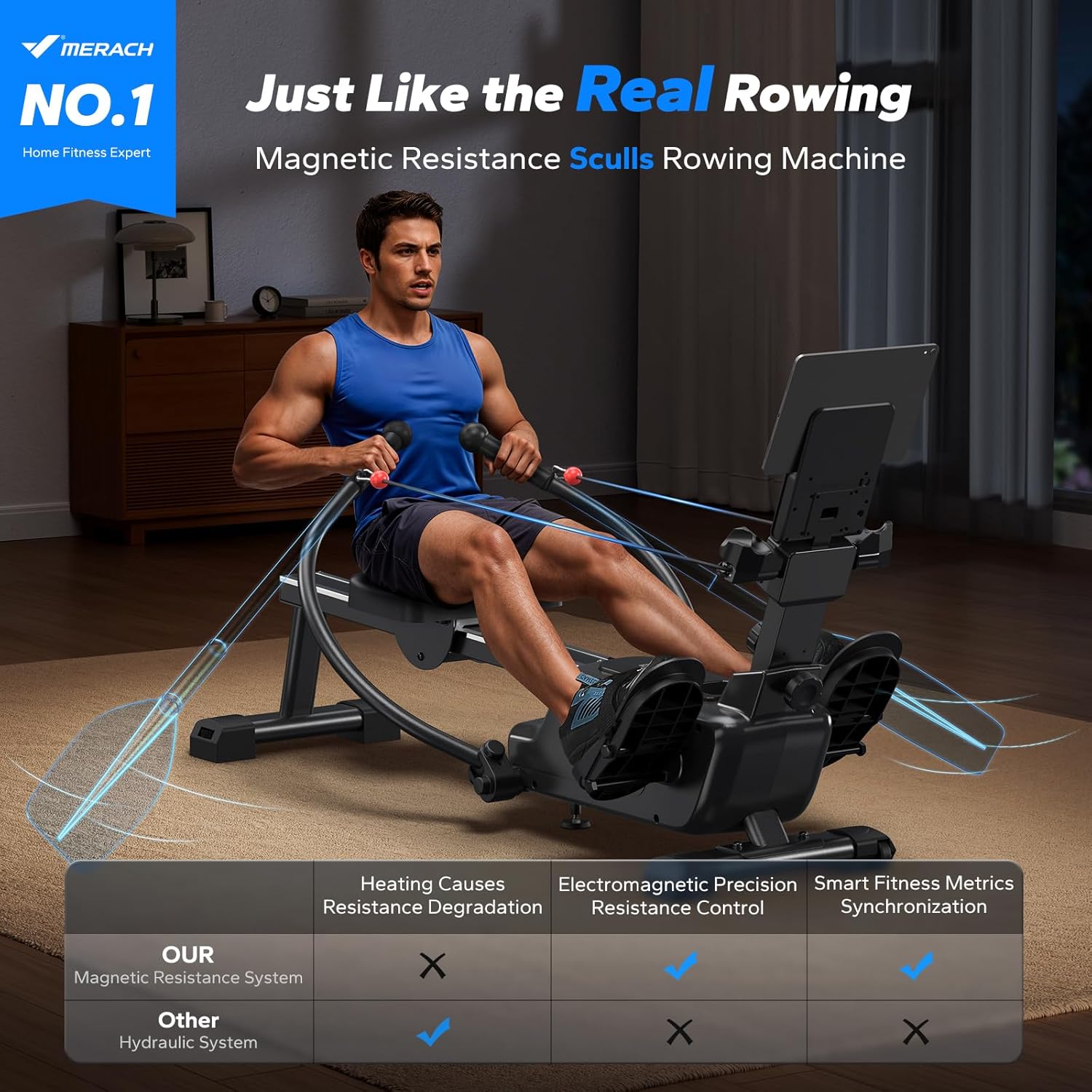
| EDITOR'S PICKSunny Health & Fitness Smart 36… | Mid-tier[Stamina Dual Air and Magnetic R…](https://www.amazon.com/dp/B07XJRJ34K?tag=greenflower20-20) | Budget pick[MERACH Sculls Rowing Machines f…](https://www.amazon.com/dp/B0DT6ZMCJ1?tag=greenflower20-20) | |
|---|---|---|---|
| Resistance Type | Magnetic | Dual Air and Magnetic | Magnetic |
| Resistance Levels | — | 8 | 16 |
| Rail Length | 51 in. | — | — |
| Monitor Type | — | LCD | — |
| Price | $599.99 | $419.00 | $339.99 |
| See on Amazon → | See on Amazon → | See on Amazon → |
What “Mid-Range” Actually Means in the Rowing World
The rowing machine market has a funny shape. There’s a crowded basement under $300 (lightweight, often noisy, with wobbly frames and limited resistance range), a premium plateau above $900 anchored by the Concept2 RowErg and WaterRower Club, and a connected-studio tier above $1,495 for machines like the Hydrow. The $300–$600 band is genuinely middle ground — not stripped-down entry product, not luxury.
Most machines in this range use magnetic resistance — a system where magnets create drag against a flywheel (the spinning wheel inside the machine) without touching it. This matters for two reasons: it’s near-silent compared to older friction-based designs, and resistance levels are consistent and repeatable because there’s no mechanical wear on the contact point. That repeatability is actually important if you’re doing any structured training — interval work, heart-rate-based sessions, or following a plan. You need resistance you can trust to behave the same way on Tuesday as it did on Sunday.
What you’re typically giving up at this price, compared to the Concept2 RowErg ($900), is performance-grade data accuracy and the air-resistance “feel” that competitive rowers train on. The Concept2 uses a flywheel with a damper (think of it as adjustable airflow into the fan housing) that mimics on-water resistance curves — it gets harder the harder you pull, naturally. Most magnetic rowers cap out at a fixed number of resistance levels (8–16 is typical) and don’t replicate that dynamic curve as precisely. For a performance athlete whose entire training plan is built around split-time data and watt output, that matters. For most of the rest of us, it doesn’t.
By the Numbers: What $300–$600 Typically Delivers
| Feature | Sub-$300 Entry | $300–$600 Sweet Spot | $900+ Premium |
|---|---|---|---|
| Resistance type | Friction or basic magnetic | Magnetic (8–16 levels) | Air, water, or magnetic |
| Monitor quality | Basic RPM/calories only | Bluetooth-capable, app-sync | Performance PM5 or touchscreen |
| Max user weight (typical) | 220–250 lbs | 250–330 lbs | 300–500 lbs |
| Footprint (folded) | Small, flimsy | Upright-fold, stable | Varies; some don’t fold |
| Warranty (frame) | 1 year | 3–5 years | 5–lifetime |
The weight capacity jump between entry and mid-range is meaningful — not just as a safety margin but as a proxy for overall frame quality and weld integrity. Verywell Fit’s roundup of home rowing machines notes that weight capacity and frame material are two of the most reliable quality signals available when you can’t evaluate a machine in person.
The Machines Worth Considering (and the Logic Behind Each)
We’re not going to list every machine in this price range — there are dozens, and most are variations on a theme. Instead, here are the categories and representative names that reviewers consistently surface.
Around $350–$450: The Serious Starter
The Sunny Health & Fitness SF-RW5515 and the Merax Rower sit in this band and represent what the mid-range looks like at its lower edge. Owners consistently report that the magnetic resistance is smooth and quiet enough to use while watching television or in an apartment setting — a genuine quality-of-life improvement over older friction systems. The monitors on these machines are functional but basic: time, stroke rate (the number of strokes per minute), calories, and a distance estimate. The distance figures on magnetic rowers are calculated approximations rather than the precision output of the Concept2’s Performance Monitor — something Men’s Health’s rowing machine coverage calls out as the key functional gap versus the Concept2 at this tier.
If your primary use case is general fitness, weight management, or supplementing another sport with low-impact cardio, this sub-range does the job well. Wirecutter’s best rowing machine guide historically flags this bracket as appropriate for casual rowers who want something reliable and quiet but aren’t tracking splits or watts.
Around $500–$600: The Committed Home Rower
This is where the mid-range gets genuinely interesting. Machines like the Concept2 RowErg Sport (which occasionally dips into this range on sale), the NordicTrack RW500, and the Rowing Machine King Stroke 550 add meaningful features: full Bluetooth connectivity to training apps, more robust frame construction, and — in some cases — dynamic resistance that adjusts automatically during a session. The NordicTrack RW500 connects to iFIT, NordicTrack’s subscription training platform (currently $39/month as of early 2026, subject to change — this is a cost you should factor into your total ownership math). If you’re willing to pay the subscription, you get coached workouts and auto-adjust resistance during class, which significantly changes the experience.
Health Harvard’s overview of rowing as a fitness modality emphasizes that rowing is a full-body, low-impact exercise engaging roughly 86% of the body’s muscles — back, legs, core, and arms in each stroke. The practical implication: a machine that keeps you rowing consistently, with enough programming variety to stay engaged, pays dividends beyond what the spec sheet shows. A $550 rower with a subscription that you actually use beats a $900 machine gathering dust.
The Real Tradeoffs You Need to Understand
Let’s be direct about where mid-range machines genuinely fall short, because this is what determines whether you’re making a smart buy or a regretted one.
1. Performance data accuracy
If you’re cross-training for competitive rowing, coaching yourself with split times (the time it takes you to row 500 meters, the standard metric in rowing performance), or following a structured wattage-based training program, the Concept2 RowErg’s Performance Monitor (PM5) is in a different class. It’s the global standard — used in Concept2’s worldwide ranking system, sanctioned by rowing federations, and the only monitor whose output you can directly compare to other athletes’ logged data. No magnetic rower in the $300–$600 range matches it for data fidelity. This is not a close call.
2. Resistance feel under high output
Air resistance (like the Concept2) gets harder as you pull harder — it’s physically self-regulating. Most magnetic systems set a ceiling. At resistance level 8 of 8, a powerful athlete may “top out” — there’s simply no more drag available. Owners of mid-range magnetic rowers in aggregated review threads note this limitation mostly if they’re already athletic or are specifically training for high-intensity intervals. For moderate-intensity training, it’s rarely an issue in practice.
3. Long-term durability at commercial intensity
Mid-range home machines are rated for home use — typically one to two users, moderate session frequency. The 3–5 year frame warranties are solid for that context. They are not appropriate for a CrossFit box, a university boathouse, or any setting with multiple daily users. Commercial buyers should not be shopping in this price band. Full stop.
4. Resale value
The Concept2 RowErg holds its value remarkably well — used units regularly sell for $600–$700 because demand is high and the machine essentially doesn’t wear out. Mid-range magnetic rowers depreciate faster and have thinner secondary markets. If there’s any chance you’ll want to upgrade in 18–24 months, that resale delta is worth factoring in upfront.
If X, Then Y: Your Decision Framework
Here’s the honest breakdown. Read across until you find your situation.
If you’re a first-time buyer who wants a reliable daily-use machine for general fitness, you’re not a competitive rower, and you want it quiet for a shared living space → The $400–$550 magnetic rower is the right buy. You’ll get a machine that serves you for years, folds upright for storage, and won’t wake a sleeping household. Don’t overbuy into the Concept2 unless you know you’ll use the data.
If you’re a performance-focused athlete, you follow a structured training plan, and split times or watts are how you measure progress → Skip this tier. Save the additional $300–$400 and buy the Concept2 RowErg. The data accuracy gap is real and it will bother you within six months.
If you’re cross-training from another sport (cycling, swimming, running) and want low-impact cardio without rowing-specific intensity goals → The $400–$550 range is arguably your best value in the entire market. You get the cardiovascular and muscular benefit of rowing without paying for performance instrumentation you won’t reference.
If you’re considering a subscription-connected machine like the NordicTrack RW500 → Build the subscription cost into your budget math before you decide. At $39/month, that’s $468/year. Over three years, a $550 machine with subscription costs ~$1,950 — comparable to Hydrow Wave territory. Know what you’re committing to.
If you’re outfitting any commercial or semi-commercial environment → This price tier is not rated for that use. Warranty terms, duty cycles, and frame specs in this range assume residential use. Look at the Concept2 RowErg Sport or Technogym skillRow and accept the price point.
The Bottom Line
The $300–$600 rowing machine is genuinely more than people expect — quieter, sturdier, and more capable than the entry-level machines it’s often lumped with in generic “best budget rower” lists. For the majority of home gym builders and general fitness users, it’s the right answer. The ceiling, when you hit it, is real: performance data, resistance feel under load, and commercial durability are all legitimately better at the next tier up. But for most people reading this, that ceiling is higher than you’ll reach for a long time — if ever.
Buy for who you actually are right now, not the athlete you might hypothetically become. Mid-range rowers have a way of being exactly enough.