May 10, 2026 • Priya Nambiar • 8 min reading time • Prices verified June 18, 2026
Magnetic Rowers Under $300: What You Actually Get for the Money
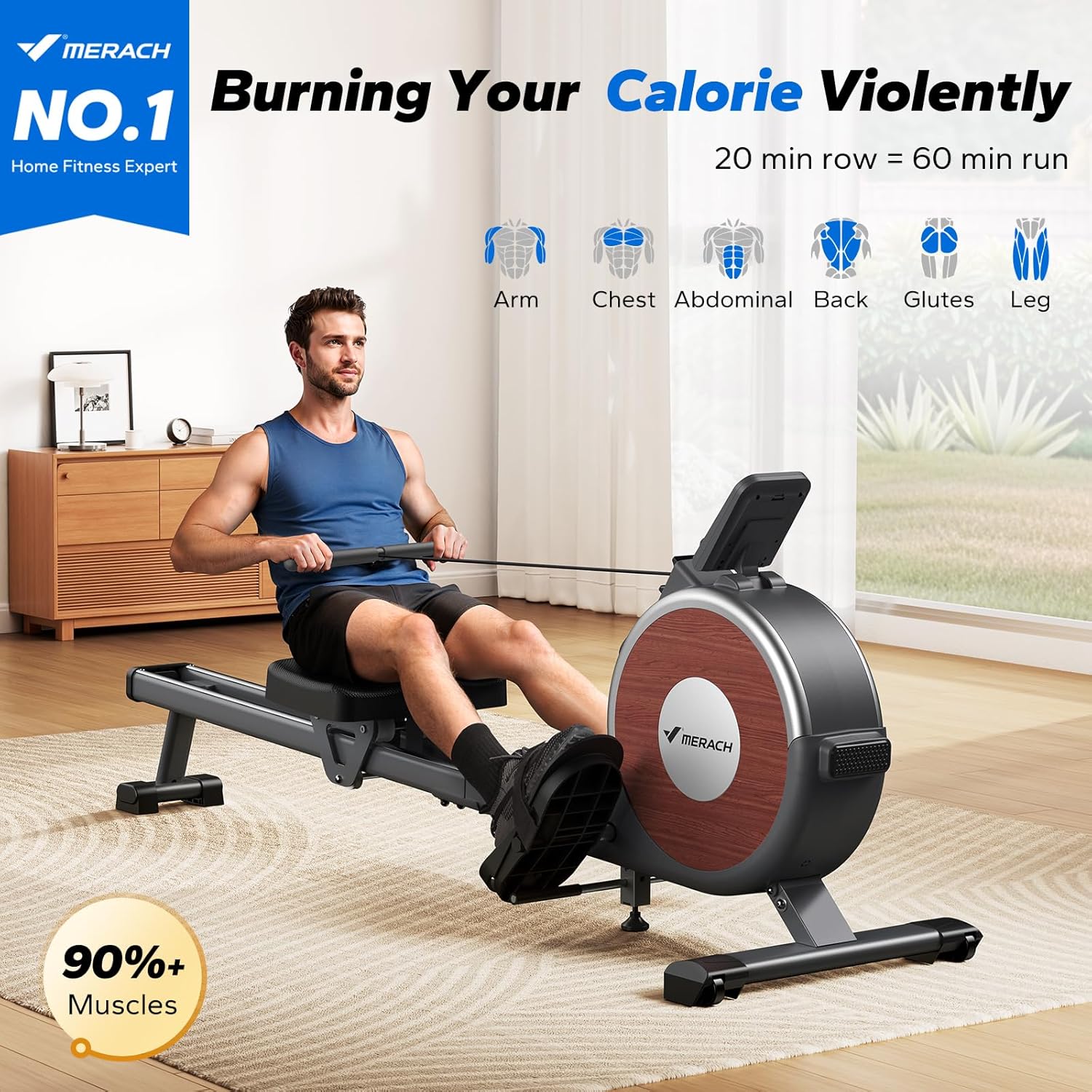
A rowing machine — in the simplest terms, a device that mimics the motion of rowing a boat — works your legs, core, and arms in one continuous movement. That full-body engagement is why Harvard Health Publishing describes rowing as one of the more efficient cardio formats available, burning a meaningful number of calories per session while placing relatively low stress on your joints compared to running. If you’re exploring home gym options and want something that delivers a real workout without a massive footprint, rowing is worth a serious look. The catch: machines range from under $300 to well over $2,000, and the difference isn’t always obvious from a product photo. This article focuses squarely on the entry-level end — magnetic resistance rowers priced below $300 — and gives you a straight answer about what you actually get, where these machines earn their keep, and when you’d be better off saving up.
Magnetic resistance (the mechanism inside most budget rowers) works by positioning a magnet near a metal flywheel — the spinning disc that creates the drag you pull against. Unlike air-resistance machines, which get harder the faster you row, magnetic rowers apply a fixed resistance level set by a dial or digital control. That means quieter operation and consistent feel, but also a ceiling on how much challenge the machine can deliver. Understanding that tradeoff is the entire decision frame here.
| EDITOR'S PICK[YOSUDA Rowing Machine for Home](https://www.amazon.com/dp/B0C1VGRX2P?tag=greenflower20-20) | Mid-tier[MERACH Rowing Machines for Home](https://www.amazon.com/dp/B0DG9T81PK?tag=greenflower20-20) | Budget pickSunny Health & Fitness Compact… | |
|---|---|---|---|
| Resistance Levels | — | 16 | 12 |
| Weight Capacity | — | 350 lbs | — |
| Bluetooth | ✓ | — | — |
| Price | $189.99 | $189.99 | $129.99 |
| See on Amazon → | See on Amazon → | See on Amazon → |
What the $300 Price Point Actually Delivers
Let’s be direct: at sub-$300, you are buying a category of machine, not a specific winner. The field is crowded with models from brands like Sunny Health & Fitness, Merax, and Stamina, and the spec sheets look nearly identical because many share the same factory origin. Across aggregated owner reviews on major retail platforms and in coverage from Verywell Fit’s rowing machine buyer’s guide, a fairly consistent picture emerges.
What you reliably get:
- Eight resistance levels, controlled by a tension knob or a basic digital console
- A slide rail measuring roughly 43–47 inches — enough for users up to about 6’1” in most cases, though taller rowers report feeling cramped
- Manufacturer-rated weight capacities typically in the 220–250 lb range
- A basic LCD monitor showing time, stroke count, strokes per minute, and estimated calories
- Foldable frames — most sub-$300 magnetic rowers fold vertically for storage, which is genuinely useful in smaller spaces
What you don’t get:
- Watts output or split-time data (the metrics that matter for structured training)
- Connectivity — no Bluetooth, no app pairing, no performance tracking over time
- A smooth, progressive resistance curve; owners consistently report that the jump between resistance levels feels abrupt, particularly in the lower half of the range
- The chain-and-damper feel of an air rower like the Concept2 RowErg, which more closely replicates on-water rowing mechanics
The honest summary: these machines are cardio tools, not ergometers. If you train with power data, interval programming, or anything resembling a structured rowing plan, the sub-$300 magnetic category will frustrate you within weeks.
By the Numbers
| Spec | Typical Sub-$300 Magnetic | Concept2 RowErg ($900) |
|---|---|---|
| Resistance type | Magnetic (fixed levels) | Air (infinite, effort-based) |
| Performance monitor | Basic LCD | PM5 — watts, split, stroke rate |
| Weight capacity | 220–250 lb (rated) | 500 lb (rated) |
| Warranty (frame) | 1–3 years | 5 years |
| Foldable | Yes, most models | No |
Where Budget Magnetic Rowers Actually Make Sense
The practitioner framing here matters: the question isn’t “is this machine good?” in the abstract — it’s “is this machine right for this use case?” And the answer is yes, in a narrower set of situations than the marketing copy implies.
Scenario 1: You’re a complete beginner who wants to build the habit before committing capital. Wirecutter’s rowing machine review explicitly notes that a budget machine can serve as a legitimate entry point for people who aren’t sure rowing will stick. If you’ve never rowed consistently and want to spend three to six months deciding whether you’ll use a rowing machine at all, risking $250 instead of $900 is defensible math. The caveat: buy with the expectation that you’ll replace it, not that you’ll grow into it.
Scenario 2: Supplemental use in a home gym where another machine is the primary cardio tool. Owners who report the highest satisfaction with sub-$300 magnetic rowers are often people using them for 15–20 minute recovery rows or warm-up sets, not as the centerpiece of a training program. For light, consistent use — think two to four sessions per week at moderate effort — the build quality holds up reasonably well over one to two years, per patterns in long-run owner reviews.
Scenario 3: Space-constrained apartments where folding matters more than performance. The vertical fold on most magnetic models is a genuine engineering advantage over the Concept2’s horizontal footprint. Men’s Health’s home gym buyer’s coverage consistently flags this as a real differentiator for urban buyers. If your apartment has one available wall and you’re choosing between no rower and a budget rower, the budget rower wins.
Where it doesn’t make sense:
- Commercial or semi-commercial use (CrossFit boxes, studios, rowing clubs — these machines are not rated or built for multi-user daily volume)
- Athletes tracking performance over time
- Anyone over the rated weight capacity, or tall rowers who push against the rail length limit
- Buyers who want their machine to last five-plus years without mechanical attention
The Build Quality Reality Check
Verywell Fit’s buying guide and Men’s Health’s roundups both flag frame rigidity and seat rail smoothness as the two most common owner complaints on sub-$300 magnetic machines. Here’s what that looks like in practice, based on aggregated owner reporting:
The frames — typically steel tubing, often powder-coated — show wobble during aggressive pulling if the stabilizer feet aren’t perfectly level. This isn’t dangerous for most users, but it’s distracting and becomes more pronounced as the machine ages. Seat rollers on cheaper models develop roughness or squeaking within six to twelve months of regular use; this is the most common repair request in owner communities. The pull handle and strap (or chain, on slightly better-built models) tend to be the second failure point.
What separates the better sub-$300 options from the worse ones, based on published spec comparison and owner pattern data: strap-driven vs. chain-driven pull mechanism (chain holds up longer under consistent use) and seat rail width and roller material (wider rails and sealed bearings last longer). Neither of these specs is prominently advertised, which is why reading long-form owner reviews — not star ratings — matters in this category.
One practical note: at this price tier, warranty service is largely theoretical. Most budget rower brands do offer one- to three-year frame warranties, but owners report that the path to warranty service is slow and often involves shipping costs that approach the machine’s replacement value. Buy knowing that you own the risk.
The Concept2 Comparison — and Why It Matters Even Here
You’re going to encounter the Concept2 RowErg ($900 at time of writing) in nearly every rowing machine research session, and for good reason. It dominates competitive rowing, is standard equipment in most university athletic programs, and is the machine against which all others are measured. Wirecutter’s recommendation for most buyers lands squarely on the Concept2, and we think that’s correct for anyone who intends to row seriously.
But the $600 price gap between a budget magnetic rower and the Concept2 is real money, and the comparison isn’t always useful if you’re genuinely in the “building the habit” phase. The frame to use: if you can honestly say you’ve rowed — on a gym machine, in a class, anywhere — consistently for at least eight weeks and want to continue, stop looking at sub-$300 machines. The performance floor you’ll hit, the lack of data, and the build quality ceiling will cost you motivation. The Concept2 is the right next move.
If you have never rowed consistently for eight weeks, the sub-$300 machine as a trial vehicle is defensible.
Decision Rules: If X, Then Y
This is the honest bracket:
If you’ve never rowed regularly and want to try without a large upfront commitment → a sub-$300 magnetic rower is a reasonable trial investment. Budget to replace it within 18 months if rowing sticks.
If you train with any kind of structure — intervals, heart rate zones, progressive overload — and need performance data → skip this tier entirely. The missing watts and split metrics aren’t a minor inconvenience; they make structured training impossible to track.
If you’re outfitting a commercial space, a club, or a CrossFit box → sub-$300 machines are not built for multi-user volume. The Concept2 RowErg Sport or a comparable commercial-grade unit is the minimum viable option, and fleet pricing from Concept2 directly is worth investigating.
If space is genuinely the constraint and you need a folding machine → the budget magnetic category has a real structural advantage here. Pair it with realistic expectations about performance ceiling and longevity.
If you’re a design-conscious buyer who cares about the machine fitting the room → save up. The WaterRower’s solid wood frame and the Hydrow’s touchscreen are in a different aesthetic category entirely, and no sub-$300 magnetic rower comes close on that dimension.
The bottom line: sub-$300 magnetic rowers are honest tools for a specific, narrow use case. They’re not scams, and they’re not serious training equipment. Knowing which side of that line your situation falls on is the whole game.