June 3, 2026 • Priya Nambiar • 9 min reading time • Prices verified June 18, 2026
Foam Rolling for Rowers: The Recovery Routine Your Back and Hamstrings Need
Rowing machines — the kind you sit on and pull a handle toward your chest while sliding back and forth on a rail — are brutally effective full-body cardio tools. They hit your legs, your core, your back, and your arms in one continuous motion. That’s exactly what makes them so efficient, and also what makes your body feel like it staged a small rebellion the morning after a hard session. If you’ve ever climbed off a rowing machine with tight hamstrings (the muscles running up the back of your thighs) or a low back that feels like it was wrung out like a wet towel, you already understand the problem. Foam rolling — using a dense cylindrical tube to apply slow, sustained pressure to sore muscle groups — is one of the most practical and inexpensive ways to speed up recovery and keep you rowing consistently. This article lays out the why, the how, and the specific moves that matter most for rowers, so you can stop guessing and start a routine that actually matches what the sport demands.
Why Rowers Specifically Wreck Their Backs and Hamstrings
Rowing is a hinge-dominated movement. Every single stroke asks your hips to hinge forward at the catch (the start of the stroke, when you’re compressed toward the flywheel) and drive back hard through the finish. Repeat that 24 to 30 times per minute for 20 minutes and you’ve put your posterior chain — the technical shorthand for the entire chain of muscles running up the back of your body, from your heels through your hamstrings, glutes, and lower and upper back — through a serious volume of work.
The biomechanical culprit is the combination of loaded flexion and rapid extension. At the catch, your spine rounds slightly forward under load. At the drive, you explosively extend. Neither movement alone is inherently dangerous, but accumulate that pattern across thousands of strokes per week without adequate recovery, and you’re asking for trouble.
Per Harvard Health Publishing’s guidance on musculoskeletal recovery, sustained mechanical stress on muscle tissue causes microscopic damage — the normal kind that leads to adaptation — but only if recovery keeps pace with training. When it doesn’t, soreness accumulates, range of motion shrinks, and performance plateaus or declines.
Foam rolling targets myofascial release — a process of applying sustained pressure to the connective tissue (fascia) wrapped around your muscles, reducing local tension and improving blood flow to the area. It won’t repair a serious injury, but as an adjunct to a structured training plan it consistently earns positive marks from athletes who use it systematically.
What the Evidence Actually Says (And What It Doesn’t)
Let’s be honest about where the science lands, because there’s a lot of marketing noise around foam rolling.
Runners World’s breakdown of foam rolling research notes that the strongest evidence sits in two areas: short-term improvements in range of motion (how far a joint moves through its full arc) and reduced perception of delayed onset muscle soreness (DOMS — the deep ache you feel 24–48 hours after hard training). The evidence for actual performance enhancement is thinner, though not absent.
Shape’s foam rolling primer flags the most common mistake rowers and other athletes make: rolling too fast, like you’re trying to sand a floor. Slow, deliberate passes of 3–5 seconds per inch of muscle — pausing on tender spots rather than skating over them — produce meaningfully better results than speed-rolling.
By the numbers:
- Rolling speed that produces best tissue response: approximately 1 inch per 3–5 seconds (per aggregated physical therapy guidance)
- Minimum effective session duration per muscle group: 60–90 seconds
- Optimal timing: 10–20 minutes post-row, while tissue is still warm
- DOMS reduction in controlled studies: up to 30–40% (per Verywell Fit’s summary of peer-reviewed literature on myofascial release)
One thing the evidence doesn’t support is using foam rolling as a warmup replacement. It’s a recovery tool. Use dynamic movement — leg swings, hip circles, light rowing at low resistance — to warm up before you pull hard. Roll after.
The Rower-Specific Routine: Five Moves That Cover the Pattern
This isn’t a generic “foam rolling for athletes” list. Every move below is selected because it addresses a specific stress pattern that rowing creates. Do them in order — you’re working from the largest muscle groups to the smaller stabilizers.
1. Thoracic Spine Extension (Upper and Mid-Back)
The thoracic spine is the section of your back from roughly your shoulder blades to the bottom of your rib cage. Rowing accumulates a ton of tension here because the finish of every stroke asks your upper back to support an extended, open-chest position.
How: Place the foam roller horizontally across your mid-back, support your head with your hands (elbows point toward the ceiling), and extend gently over the roller. Shift slightly up and down — one segment at a time — from the bottom of your shoulder blades toward the top. Spend 60–90 seconds total. You should feel gentle mobility, not cracking pain.
Men’s Health’s roundup of foam roller recovery protocols consistently points to thoracic work as the highest-leverage move for athletes whose sport involves repeated spinal flexion and extension — exactly the rowing pattern.
2. Lumbar Para-Spinal Release (Low Back — Indirect Method)
Important clarification: do not roll directly over your lumbar vertebrae (the lower, freestanding bones of your spine). Rolling directly on the lumbar spine puts uneven pressure on the vertebrae without the rib cage to stabilize things, and most physical therapists advise against it.
Instead: Angle the roller slightly to one side so you’re on the muscle column beside the spine (the erector spinae group), not directly on the vertebral bones. Hold a tender spot for 30–45 seconds, breathe through it, and shift your body weight subtly. Repeat on the other side.
This indirect technique addresses the actual source of post-row low back fatigue — the erectors and quadratus lumborum — without the risks of direct spinal compression.
3. Hamstring Roll (Full Length)
This is the move most rowers already do, but usually wrong. The common mistake is putting both legs on the roller simultaneously, which halves the pressure and makes the move nearly useless.
How: Sit on the floor, place the roller under one thigh just above the knee. Cross your opposite ankle over the working leg to add load. Roll slowly from just above the knee to just below the glute — one direction, not back and forth. Find the densest, most resistant spot and pause there for 30–45 seconds before continuing. Two full passes per leg, then switch.
Verywell Fit’s guide to foam rolling technique specifically highlights the single-leg loading approach as the most effective way to generate adequate pressure on the hamstrings without needing a heavier roller.
4. Glute and Piriformis Release
Your glutes aren’t just movers in rowing — they’re stabilizers throughout the entire drive phase. The piriformis (a small, deep muscle in your glute that runs diagonally and can compress the sciatic nerve when chronically tight) is a notorious problem spot for rowers who clock serious weekly volume.
How: Sit on the roller, cross your right ankle over your left knee (figure-four position), and shift your weight onto your right glute. Roll slowly around the area — front to back, slightly diagonal — pausing wherever you find a hot spot. One to two minutes per side.
If you feel a sharp, shooting sensation down your leg, stop — that’s nerve involvement and needs professional assessment, not more rolling pressure.
5. Hip Flexor Release (Floor-Based)
This one surprises rowers. Hip flexors — the muscles at the front crease of your hip that draw your knee toward your chest — work hard at the catch to manage your compressed position. They also get chronically shortened if you sit at a desk between rowing sessions, which describes most of us.
How: Kneel on one knee, place the roller under the front of your rear thigh just above the knee, and slowly let your body weight sink into it while keeping your core tight. This is less of an active roll and more of a sustained compression hold. Thirty to forty-five seconds per side.
Choosing the Right Roller: What Actually Matters
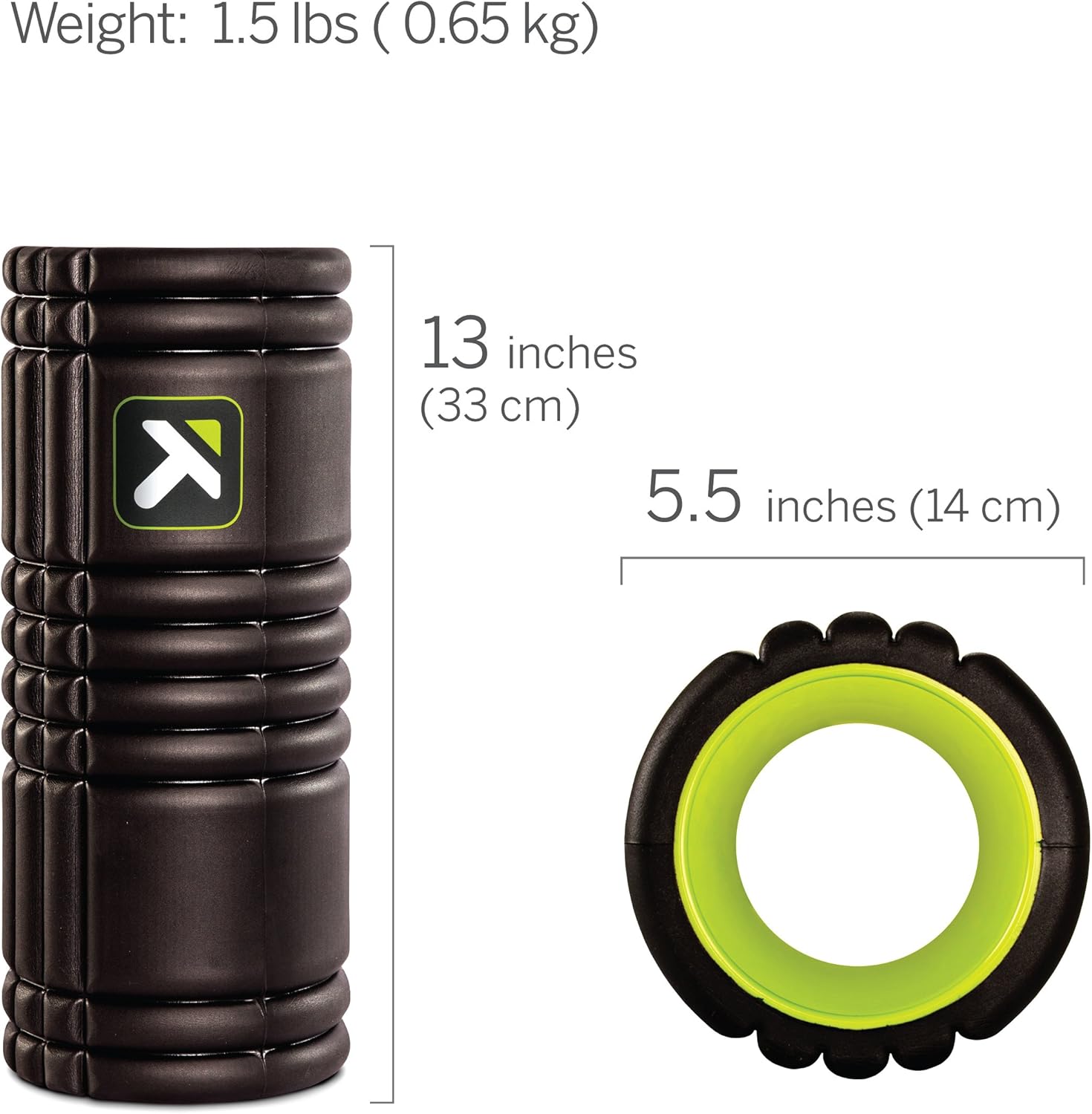
The foam roller market runs from $15 hollow-core cylinders to $60+ vibrating units. For rowers, here’s the honest breakdown:
Density matters more than texture. A medium-density roller — firm enough to generate real pressure, not so hard it creates protective muscle guarding — suits most people best. If you’re very new to rolling or have acute soreness, start softer. If you’ve been rowing 5+ days a week for a year and have dense, conditioned tissue, a firmer surface makes sense.
Vibration rollers (battery-powered units that add mechanical vibration to the pressure) show up in several peer-reviewed recovery studies as modestly more effective for range-of-motion improvements than static rollers. They’re not magic, but if you’re investing in recovery as part of a serious training system, the upgrade is defensible.
Standard length (36 inches) is more versatile than travel-size (12–18 inches) for the thoracic work described above. You need the roller to span your full back width. A short roller makes that move awkward.
If X, Then Y: The Decision Rules
If you’re rowing fewer than three times per week and your soreness resolves within 48 hours without intervention — a basic $20 medium-density roller and 10 minutes post-session is all you need. Don’t over-engineer this.
If you’re on a structured plan with four or more sessions per week — split-based training, interval work, distance targets — treat this routine as non-negotiable. Your hamstrings and thoracic spine will show the accumulated fatigue first, and ignoring them compresses the timeline before something actually goes wrong.
If you’re experiencing persistent low back pain that doesn’t improve after 48–72 hours, or pain that radiates down a leg — stop rolling and get a professional assessment. Foam rolling is a recovery adjunct, not a treatment for injury.
If you’re coaching or outfitting a club or box with multiple rowers sharing equipment, add foam rollers to your floor kit the same way you’d add resistance bands or a clock. They’re low cost, high-use, and the rowers who actually use them consistently tend to miss fewer sessions.
The bottom line: rowing is hard on your posterior chain by design. That’s not a flaw — it’s why the sport produces such good fitness adaptations. A consistent 10-to-15-minute rolling routine after your hardest sessions isn’t recovery theater. It’s maintenance on the equipment that actually matters — your body.